Tuesday, January 30, 2024

The Vault of Greed


    Greed's Temple to Mammon stands on a high mountain range. It is said that one can see all the kingdoms of the world from these peaks. The facade is of classical design with gilt pillars, but the building itself is more modern. It appears to have been added on to by varied minds in diverse ages. The temple contains all the amenities one would expect for the center of one of the world's oldest and most established religions, including a state of the art broadcast studio. The Lord of Lucre presides over services every Monday morning, but followers can catch up on the latest message at their convenience, on air or online. Greed is second only to Lust in media exposure.

    The Temple is open to all, but the Vault is only for members. The chamber containing the first great door is modelled on something like classical lines. Made of Tyrian bronze, the Gate of Grasping will open only to those who pay the steep entrance fee. Members from around the world bring many such investments in hopes of profitable returns. After paying, the new Initiate is sprinkled with "gold dust", actually ground-up pyrite, and allowed within. This section is as far as most followers get. The price of admission climbs higher as the Vault gets deeper.

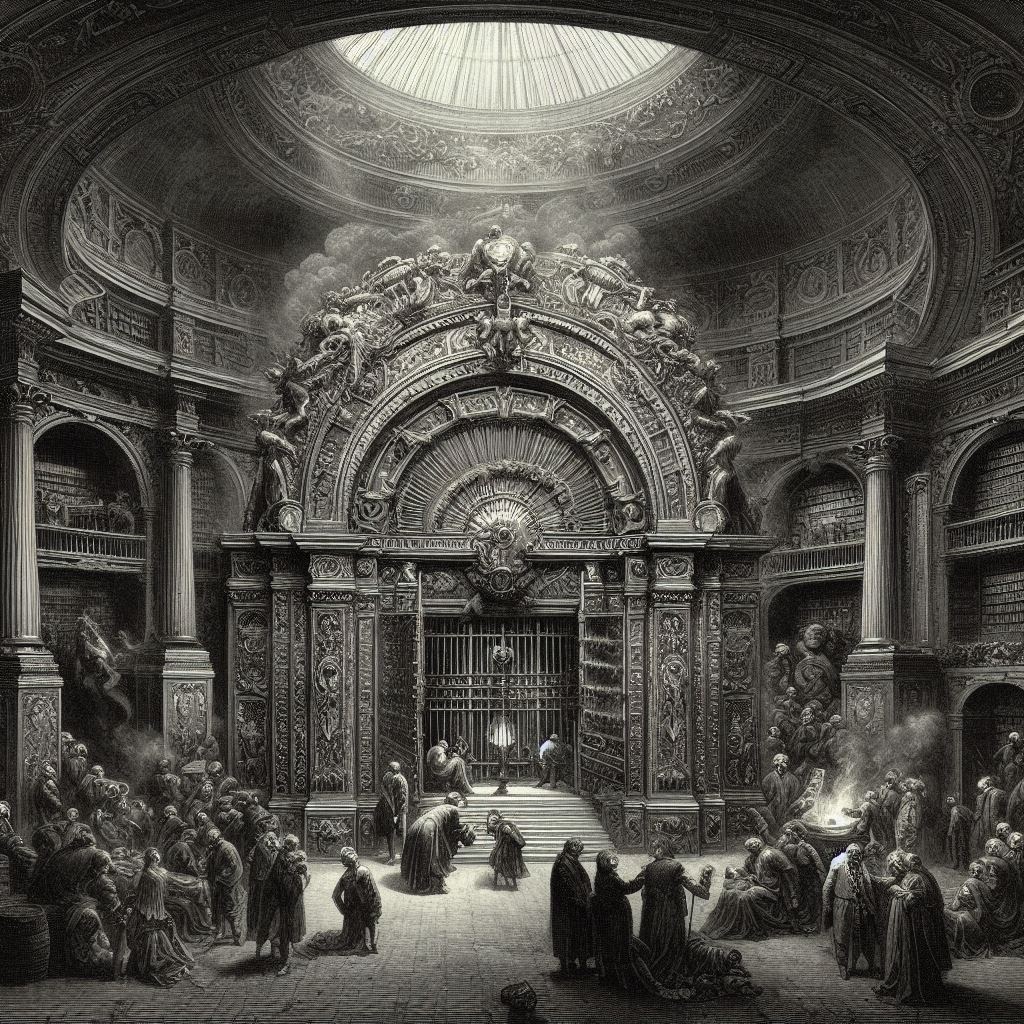
    Deeper within the mountain one comes to a somewhat Baroque chamber lit by a sky-well and ringed with bookcases full of ledgers. This room contains the next door, the Gate of Avarice, made of steel bars covered with silver. Here, would-be entrants must surrender all belief and even opinion to the Great Device. A detailed record of each one's words and deeds is kept, to be used against him if the Device deems it advisable. The policy of the Device is slowly but continually shifting, so that what was acceptable one year is anathema the next. Bent to its will like grass to the wind, the new Adepts enter Avarice and trudge ahead, past exhausted mineshafts that are now used for storage.

    At the end of the long sloping tunnel is the last chamber. The room is artificially lit from the top, where steam from a nearby hot spring is piped in to simulate clouds. The moisture is constantly peeling flecks of sky-blue paint from the cavern ceiling. In contrast, the walls of the grotto are given over to a hideous riot of rococo excess and golden statues. Here one finds the final door, the Gate of Cupidity. Its slender bars are of titanium alloy, coated with gold. A steady rhythmic sound can be heard from behind the doors. One might almost mistake it for the heartbeat of the earth herself. It is thousands of hearts beating in depressing unison, the last sacrifice of Greed's most devoted followers. Having been divested of their final fragment of humanity, the newly Hollowed are given a gray suit and and a beige briefcase. They are then sent forth into the world, conquering and to conquer.

    And yet the hearts drone on in dull monotony: "More... More... More..."

Monday, January 22, 2024

Gods-in-Waiting: The Xin


       North of the Shan hills lies the land of their allies, the Xin. The Xin capital, Zei Shufang, lies at the terminus of the Great Road, the trade route that brings goods from the distant west. Access to this trade route has made the Xin wealthy, earning them the envy and ire of the Huo kings and many of the feudal nobility. The former King had been making plans to move his capital to Xin and take control of it directly at the time when the Shan started their rebellion. The Xin were not eager to have their ancient liberties infringed upon, so it seemed natural for them to join the Shan. The alliance has prospered, and they continue to do a brisk trade (with hefty markup), despite catering to a smaller number of provinces.

The Xin stand out. Brown and red hair are common, a mark of their mixed ancestry. The laws of the marketplace govern their conduct. The quiet stall sees no traffic, so Xin tend to be loud, outgoing, and shamelessly self-promoting. Whereas in the rest of Liangyu even nobles are expected to be reserved and self-deprecating, a Xin commoner will begin listing all of his skills and accomplishments within moments of meeting you. He will constantly be mentioning people he knows who could get you a really good bargain on this or that. And he will keep bringing these things up at every opportunity.

Like his pride, a Xin man wears his passions openly. Lamentations of sorrow or boisterous declarations of love are given with drama and earnestness. He is also quick to lash out with word or hand if he feels slighted. But his anger passes just as quickly, and he will soon be laughing and buying the next round of drinks. A Xin seems to have little thought of revenge or resentment. When pressed on this, he may shrug and say "Grudges earn no gold." Or he may laugh and say "If it's a fight you want, just wait till I'm a god. Then we'll have a proper match."

And here lies another oddity about the Xin, their view of the afterlife. It seems to be a matter of perspective. While a pious Shan's view of the Bright Courts centers on his deified ancestors, the Xin is fixated on his own future apotheosis there. Both are theologically correct (at least, according to the ancient traditions), but the two attitudes could not be more strikingly different. A Xin's entire life is thought to be a grand journey toward a glorious enthronement.

Perhaps it is this self-assurance which makes them so ostentatious with regards to appearance. They wear exotic furs and expensive fabrics worked into bold patterns of varied hues. Jewelry is also popular, the gaudier the better. It doubles as wealth storage, at least for those strong or nimble enough to keep hold of it. There are plenty of quick hands eager to relieve them of the burden.

Thieves of all stripes are a constant problem here. Most work in highly organized networks, each with its own chieftain who plans heists and protects underlings with bail and bribe. In return he takes a fixed cut of the loot. Lone wolves do crop up occasionally, but they rarely last. It is a difficult thing to dodge both criminals and the law, particularly when they work so well together. Of course, you could always hightail it for the desert, but you'd better have a faster horse than the gendarmerie.

The introduction of western horses has changed life for the Xin. Liangyese horses tend to be small, best used in teams to pull wagons or chariots. The new horses being imported are stronger and swifter, allowing for the the development of true cavalry. The Xin have taken to them quickly, riding into combat wearing bright silk over bronze armor and yelling piercing war cries. Fearless and energetic, Xin warriors have made a name for themselves both as soldiers in the war and as caravan guards along the Great Road.

The Xin have profited greatly from the war, both in plunder and the arms trade. It is rumored that some of them are playing both sides by selling to the enemy, hoping to drag the war out as long as possible. This is hotly denied and would be a major scandal if it could be proved.

Tuesday, January 16, 2024

The Last Book

    A little book lies unopened on the floor of Sloth's tomb.

    It was once larger. Far larger, they say, containing all of the Great Books which had yet to be written. Not the most well-written or the most read, but the most crucial-- the books that shape the destiny of a world.  Whenever an author completes one of these in the realm outside, the text of that work disappears from this tome. The strange volume has diminished greatly over time, as its pages vanish from beneath its cover to appear in the hands of humanity.

    What the truth of this matter is, I cannot say. I did not open the book on either of my visits, as my purpose was otherwise and time was pressing. But I can attest that it was noticeably smaller the second time I was there. Rather disturbingly so. I can only guess, but surely there is room for only one more book within those few pages.

    The Last Book! What will it say? What minds will grapple with it, and to what path will its words bend them? Who will wrest this Book, the Last Book, from the House of Unbeing?

Tuesday, January 9, 2024

Greater Lizards of the Western Hills


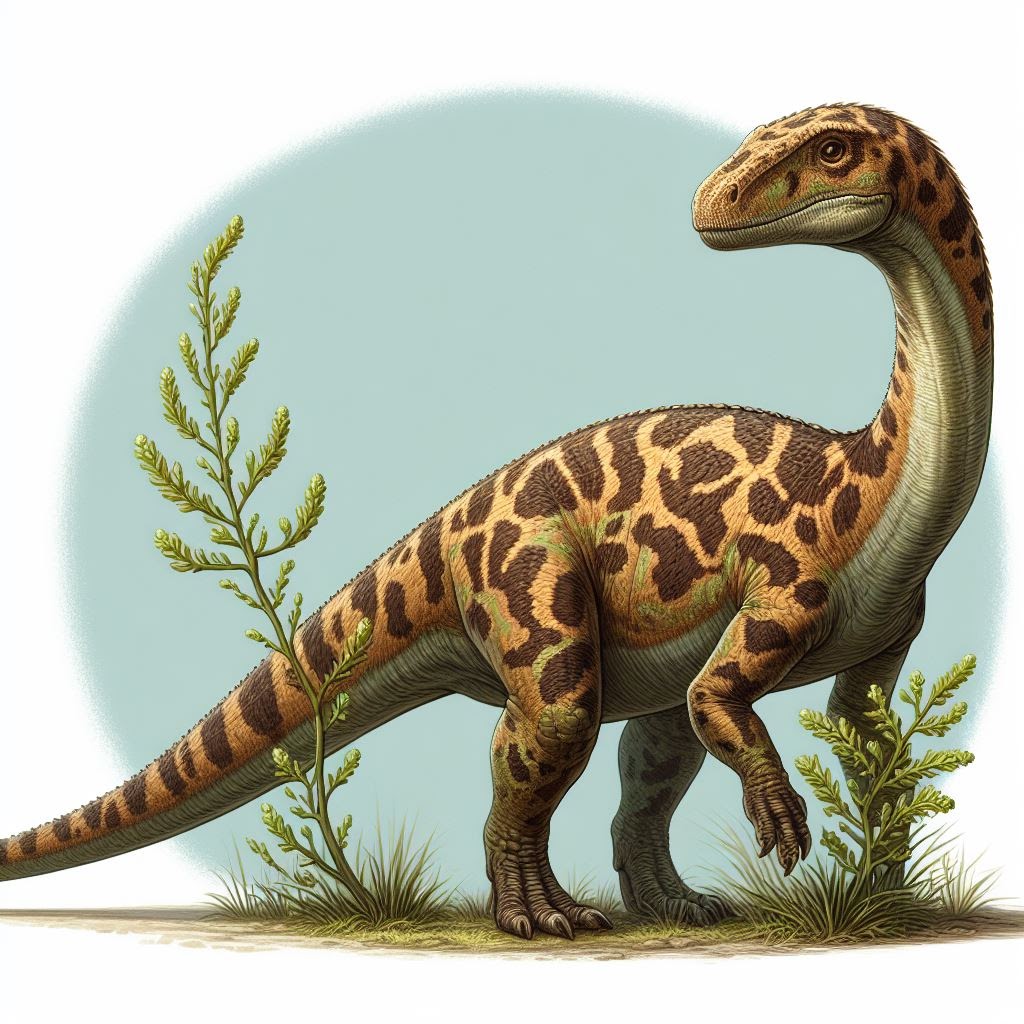
   Wajue are reptiles roughly the size of a sheep when full-grown. In the wild, they use their forepaws to dig dens on south-facing hillsides. Wajue mate for life, and each pair has its own den. Dens are often clustered closely together for mutual defense, and wajue take turns standing watch to warn of approaching danger. If they sense a threat they will emit a loud yelp which alerts the clan.

    Wajue are opportunistic creatures, as likely to snack on rodents or birds as they are to eat fruits or fungus they find on the forest floor. They not above scavenging other creature's kills. Markedly clever, they are known to set ambushes and lie patiently in wait for unwary prey. They have been known to dig their way into henhouses, and many farmers view the wild ones as nuisances. In some places they offer bounties.

    Their social behavior has made domestication a relatively straightforward process, and tame wajue often fill the role of both cat and dog for many Shan. They are excellent at pest control, being able to dig after vermin and pounce swiftly on landing birds. Their instincts make them natural sentries. Often they are used to guard grain silos both from pests and prowlers. Grain is one of the few things wajue do not eat.

    Tame wajue have sometimes been exported outside of Shanguo. While they are not common, they can be found in eastern towns or even the trade cities of the north. But the wild ones are only found in the hills of Shanguo. Wolves, tigers and snow leopards will fight them but not feed on them. Bears and zhao will eat them if they are hungry.


    Zhao will eat just about anything that size, unless they are well-trained. These winged reptiles were once common in the river valleys of Shanguo. Their appetite for small farm animals led to a campaign against them. Nests were discovered and destroyed. It has been a long time since any of the fliers have been spotted in the wild. But many eggs were taken back to Hei Chao, for domestication.

    The zhao is unusual in that it is capable of carrying a human while flying-- a small human, at least. There is a definite weight limit to what they can carry, so zhao riders tend to be on the smaller side-- maidens, youths, midgets. Although its scales offer some protection, the zhao is not suitable for direct combat. Zhao riders serve as scouts, sentries, and couriers. Being able to bypass the long ground journey to maintain lines of communication has been critical to the war effort thus far.

    Tame zhao are conditioned to accept human presence from the moment of hatching. Those raised at Hei Chao are the only living ones known to exist, and the breeding pool is dangerously low. The Shan would pay handsomely for any eggs found in the wild. Of course, the Huo might well pay more.


    The keening cry of the sheng echoes through the densest forests and most forbidding slopes of Shanguo. Bipedal and surefooted, these herbivores can navigate terrain that would leave most creatures bewildered. They are uniquely suited for the steep rocky slopes, their thick soles shielding their feet while providing excellent traction. Their senses are keen, and their feet can pick up tremors in the earth, alerting them to the presence of creatures miles off. Their spatial awareness and agility allow them to pass through woodlands with swiftness and even stealth, flitting among the trees like gray ghosts.

    The sheng are sacred to the Shan, who believe that their ancestors sometimes reincarnate in this form. The hunting of these beasts is punishable by death, and only those of the Shan bloodline are allowed to ride them. For a long while this law was hardly necessary, for the beasts will not easily bend their necks to strangers, but must be raised from the shell to accept the smell of particular humans and their close kin. These days there are enemies who would pay dearly for sheng eggs, and the nests must be closely guarded.

    The use of sheng in mountain warfare should not be underestimated. Both as mounts and as pack animals, sheng allow for quick movement across terrain that would bog down man or horse. The ability to deploy armies from Hei Chao swiftly across treacherous mountain trails has saved the realm from canid invaders from the west countless times in the past. Now it is used to harry and confound the wooden soldiers of the east in brutal hit-and-run strikes.


    There are other large reptiles in Shanguo but only these have been tamed by men. None are known to prey on humans, but this does not make them harmless. The large duckbill, for instance, grows up to fifty feet long and has been known to capsize boats if they come too close to it. Hornbrows, stonepates, clubtails and spearflanks should all be treated with caution if approached in the wild.

    The canids say that such beasts were far more widespread long ago, but a race of serpent-men slew most of them.

Monday, January 1, 2024

The Tomb of Sloth

     In the primal war between Good and Evil, some spirits refused to take a side. But abstaining from a choice is itself a decision, and they soon found themselves in the thrall of a new master. After the great expulsion, they were tasked with building a monument for him.

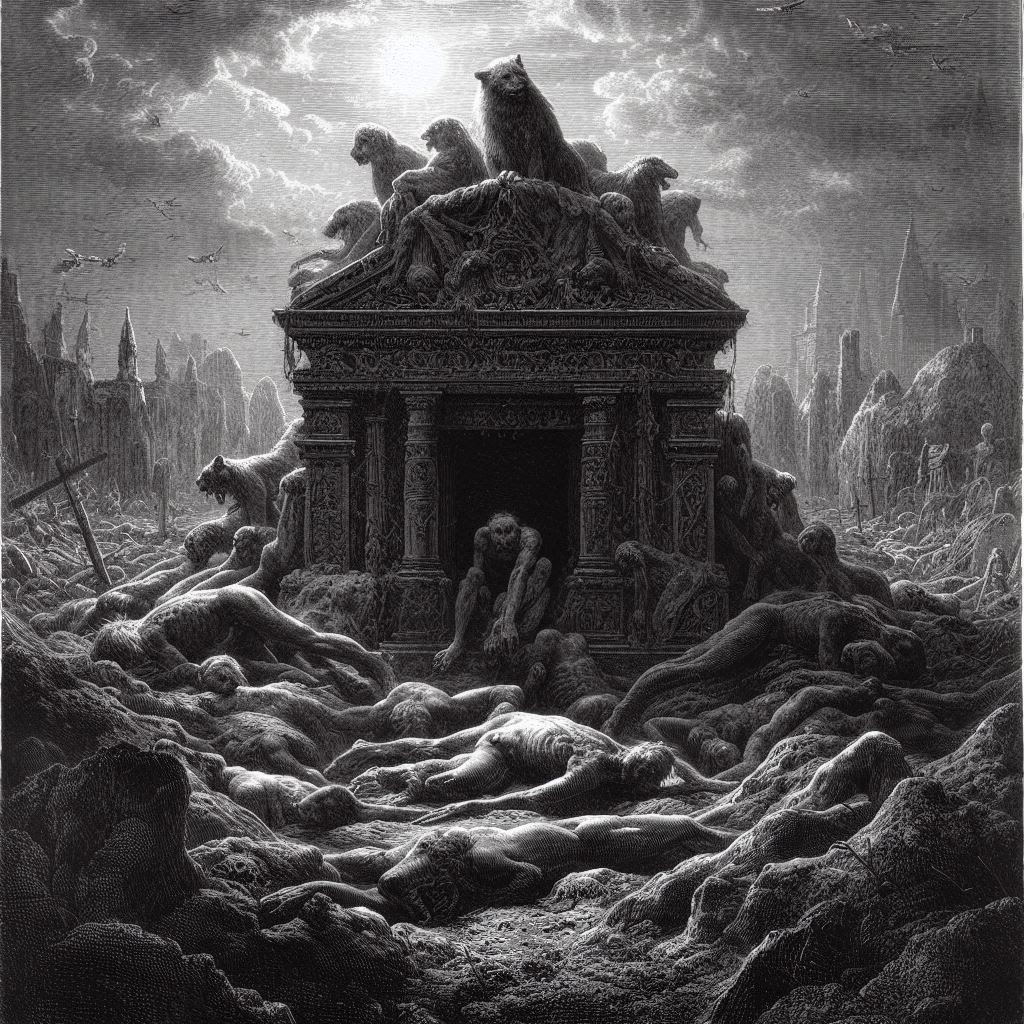
    The Tomb of Sloth is found on the borderline between Cowardice and Apathy-- claimed by neither but frequented by both. As the only serious rival to both God and Satan, Sloth's memorial was originally intended to be far larger. Unfinished buildings dot the surrounding landscape, slowly falling into decay. The plain hums with murmured words, indiscernible, drifting on the wind. The ghosts of things half-formed haunt this place-- thoughts half-finished, deeds half-done. 

    The tomb's attendants are a sordid lot, their forms now bestial, now human, now some unholy parody of living flesh. Their vacant minds are in such thrall to Sloth that their very bodies have rebelled, twisting into strange shapes from sheer revulsion to the unremitting monotony-- desperate for change, any change. Their movements are languid and awkward as they slink, squat, or sprawl about the monument. Anyone approaching the structure will soon learn why, as the weight of Sloth's influence causes the steps to slow and the spine to stiffen. The air feels thick and sound is muffled.

    The interior of the mausoleum slopes downward to a natural cave, lit by fissures in its roof. A statue stands here depicting the Recumbent King. Gathered around are the lieutenants of Sloth's Inner Circle, half submerged in caked mud. Their eyes track you as you approach. Those that have a free limb may attempt to hinder you. As Sloth's agents, their gaze is hypnotic and their touch paralyzes. Proceed with caution. Within the base of the sculpture is a tunnel, near choked with debris. There is barely room to slither through it to the lower cavern which contains the sepulchre itself. (It may perhaps be easier to climb over the monument and drop down through the natural opening beyond, but such insolence will not go unpunished).

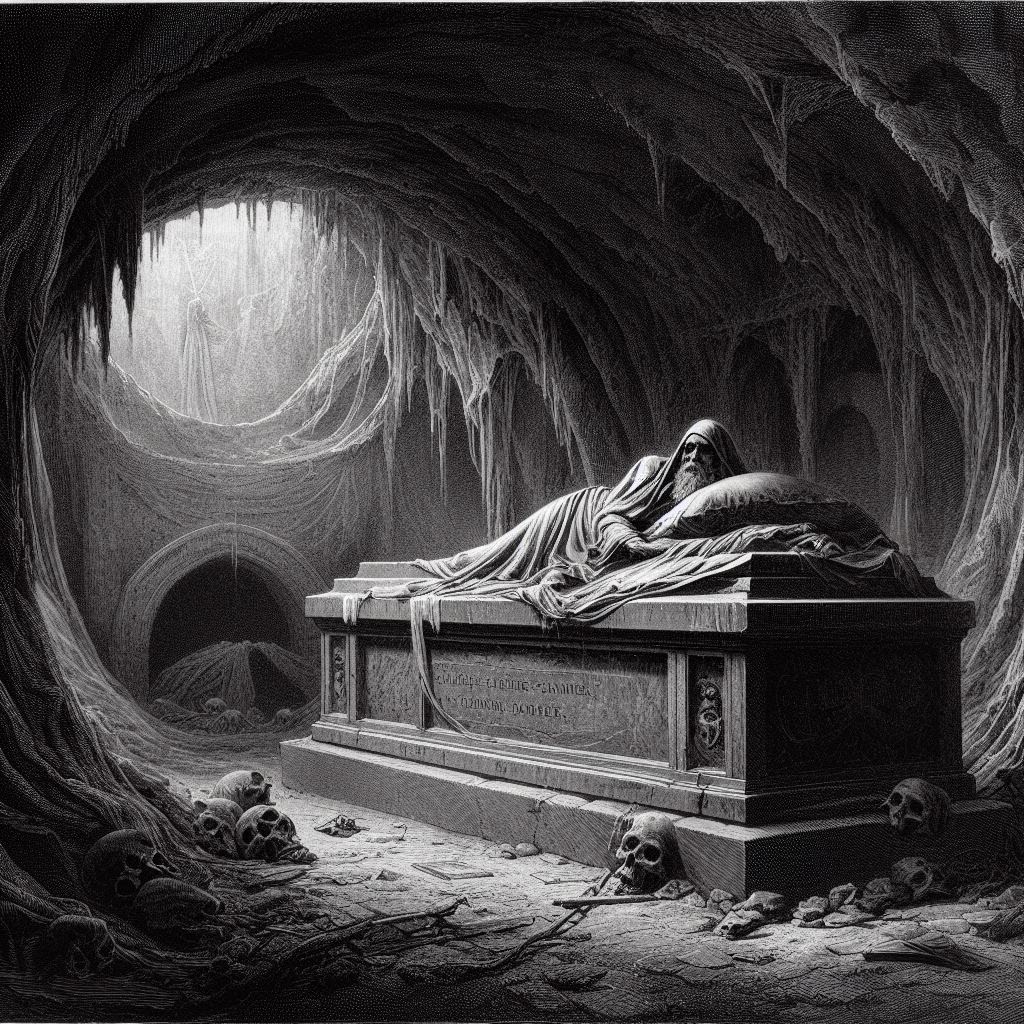
    The weight on one's body and mind increases as one draws nearer to the Lord of Torpor. His presence saps like summer heat and numbs like winter chill. Yet the cave itself is lukewarm. The tepid waters which hollowed out this space vanished ages ago. The silence of the dry air is broken only by the shallow breathing of Sloth himself, stretched out on the top of his tomb. He has lingered here for untold centuries-- even dying is too much of a bother. He has outlasted his most devoted followers, who leave behind little more than a few hardened skulls and the sands of a spent hourglass.

    Thus to enter. Leaving is another matter. Sloth's oppressive presence will hinder movement and deaden thought. It will also daunt your will. You may feel it impossible to drag yourself back through the cramped tunnel and the grasping sycophants and the lurching hulks of the plain-- certainly not without a rest first. A quick sleep, a cat nap. Just a brief shutting of the eyes... of course, I don't need to explain to you that such a sleep would have no waking. If you truly must visit this place, it would be best to bring some form of magic that can bear you swiftly away.

    How did I escape? That's another story.

Thursday, December 28, 2023

The Duke, the City, and the Priest

 The Duke

    As a young man, Qinshi knelt by the bedside of his dying father, the old Duke. The Black Wolf's hair had long since turned white, but his grip had lost none of its strength as he grasped his son's hand. He refused to die until Qinshi swore to see the war through to the end. And so, fired with the fervor of youth, the young man swore before Heaven and Earth to install the true heir on the throne of Liangyu.

    That was long ago. Since taking up the obsidian scepter, he has lost brothers and friends to the war. Most recently he buried a son, and he still wears white mourning garments. He is beginning to feel his age, and the hairs of his beard have begun to grey.

    His vow constrains him. Such a thing is not lightly cast off. But in his heart has has begun to loathe it, resentment gnawing at him like a cancer. He feels trapped in a war he cannot win, for a cause that will do him little good. Yet breaking the vow and abandoning the war would hold perils of its own. His oath was made before gods and men, and to walk away from it would be a great breach of loyalty, a betrayal of his people. Furthermore, if his three cousins do not conquer the East, he fears they may turn on the West and take his domain for themselves. And so he bides his time in frustration, weary of counsels and campaigns.

    All this he keeps in his heart. To the world Duke Qinshi is a stone-faced politician, maintaining the customs and policies of his ancestors. His duties extend not only to the oversight of the realm and the prosecution of the war but also to the clan at large. As senior member of the clan he is responsible for keeping the various branches of the family in line. Marriages of clan members must be approved by him first, although this is usually a formality in all but the most important cases. He also presides at funerals and the spring ritual honoring the family's ancestors at Hei Chao. And every year he travels to keep the Autumn Feast in Zhigen.


The City

    Zhigen is built on a low hill, bounded by a long bend of the river on its west, south, and east sides. It began as a collection of huts along the riverbank, and became a trading hub for the scattered settlers of this rugged land. Over time it grew in wealth and prestige, an outpost in the wilderness, overseen by an honorable family, the ancestors of the Huo and the Shan. On the crest of the hill they built a stronghold, the House of Weathered Boughs. The north side of the hill became dotted with their tombs, and the ancestral hall was filled with their memorial tablets.

    When a man dies, his spirit goes to be with his fathers, and his children inscribe his name on a memorial tablet. The tablet is placed in the ancestral hall alongside those of his father and grandfather, as far back as the founding of that particular branch of the clan. Though his remains crumble to dust, it is believed that part of his spirit remains within his memorial tablet, providing a link to the next world. Ancestors are believed to represent the interests of their descendants to the Lord of Heaven in the High Courts of the afterlife.

    The rulers of Zhigen became the clan we now call the Huo. When the Huo left Zhigen to rule in the east, they packed up the ancient memorial tablets into ox carts. But when it came to the oldest tablets, the ones of the ancestors both Shan and Huo claimed descent from, the cart broke down and the oxen refused to move. An oracle was consulted and it appeared that these ancestors were reluctant to leave the city they had spent so much time and toil to build. So it was agreed that these memorial tablets would remain at Zhigen in the Hall of the First Fathers. A member of the Shan would be appointed to watch over them, and every autumn the Huo King and the Duke of Shan would come to pay their respects. (In these days, of course, the King and his court do not attend, and the Huo clan are represented solely by the Three Princes, their households, and a handful of relatives who have come over to their side.)

    Over the generations, the prosperity of the Huo Dynasty was attributed in large part to the intercession of the First Fathers. They came to be viewed as powerful and benevolent patrons. Petitions to their shrine came from all over the province, and for a time from the the entire kingdom. Anyone of that bloodline could expect a hearing, but so could loyal retainers of the King-- ostensibly any of the King's good vassals. Pilgrims flocked to the city, which grew to accommodate them. Many donations were made in hopes of (or in gratitude for) favorable outcomes. The temple became wealthy, and the role of Custodian was highly sought after.

    Often given to a cousin of the Duke of Shan, the lucrative position attracted cynical and self-serving men. Corruption bred there. But every so often a man of piety would, against all odds, receive the post and weed out the worst offences. Such a man is the current Custodian, Yanshi.


The Priest

    Yanshi seems to be that rarest of all things, a good man. He is driven by his duty to both gods and men, and his fervor for both is self-evident. He has abolished the entrance fee to the Temple, and spends long days listening to and counseling petitioners. Both lowborn and high find an open ear and much counsel. He is learned in the ancient songs and tales, but seems to also be a keen observer of men. He is well spoken of in all places.

    Yanshi has very nearly succeeded in rooting out corruption from the city's priesthood. He insists that the temple should be allowed to choose its own Custodian rather than remain at the mercy of court politics. In this way, he hopes, Zhigen may maintain its noble purpose with due reverence for the gods and compassion for mankind. The Duke is skeptical that such a move would truly do much to stave off the corruptions that keep cropping up in the city. And he is keenly aware that such autonomy could eventually prove a threat to the realm. On this matter there is no harmony between the two men.

    There is a further matter which divides them. As the Custodian of Zhigen, Yanshi is more sensitive than most to the ancient ties between the Huo and the Shan. To him they are close kinsmen, and he sees the war as nothing but evil, infighting between two branches of the same tree. He is obedient to the Duke as head of the family, but he considers it his outspoken duty to argue constantly for peace. He can quote the exact verses from the Book of Odes which support his ideas, and does so often-- sometimes without preamble. It is said that he enters the Hall daily and remonstrates with the ancestors about the state of the war, now scolding, now pleading. Yet he maintains his loyalty to the clan and gives aid and support to the army whenever they come through.

    While privately the Duke feels that Yanshi may be right about the war, he also bitterly resents him for pressuring him when he already feels so conflicted. Yanshi, meanwhile, views the Duke's vow as a weight dragging the realm deeper and deeper into chaos. These two major issues have exacerbated a host of petty disputes between the two, causing even small sparks to blaze into searing flames. The Autumn Feast has become an awkward and uncomfortable affair for nearly everyone involved. At the most recent one harsh words were exchanged, and the two men nearly came to blows in the Hall itself. The growing rift between these two influential men can only spell trouble for the realm. Any public action by one against the other would be a terrible scandal due to their positions and reputations in the clan. Certainly it is hard to imagine a loyal son of the Shan willingly seeking to harm either of them. But the war has brought many strangers into the realm as mercenaries or auxiliaries. Who can say where a careless word may lead?

Tuesday, December 19, 2023

The Camp of Envy


  The camp moves about, springing up seemingly overnight near its current target of ire. Moving through the camp you'll meet businessmen muttering about long-dead rivals and neighboring kings sketching up battle plans against each other. Outcasts, has-beens, and jilted lovers all crowd around fires that give heat but no warmth. Everyone seems to subsist solely on black coffee, whiskey, and tobacco. Smoke hovers above the area, curling in twisted patterns like a brood of ghostly vipers.


Camp materials seem to be scavenged or scrounged from other sources. Visigoths use classical columns as benches. A pirate captain has made a pavilion from captured sails-- all dragged here painstakingly across miles of desert.

Around the camp, shady vendors promise quick fixes. Every other person seems to have a book or a tract they want you to read, right now, while they give commentary. Wild-eyed speakers whip up the placard-wielding crowd for fresh crusades. Guitars and occasionally odder instruments crop up here and there.


The trampled dirt here is not a soil from which deep friendships spring. Tenuous alliances shift in the everchanging wind, and any elevation in the fortunes of one is likely to draw the resentment of others. But while the status quo lasts, there is a certain grim camaraderie among Envy's followers.

For some, the camp is a permanent residence. For others it is a stepping stone to a career in the army of Wrath or the temple of Greed.