Tuesday, February 27, 2024

Canids in Liangyu

         For as long as Man can remember, the clans of the dogmen have descended from the Imavant to claim land for themselves. While the long struggle bred resentment towards the species, there were some canid tribes that impressed the Dukes with their skill and honor. When the rebellion broke out the old Duke, wary of a war on two fronts, brokered an alliance with these clans. In exchange for their help, they received land. Some were settled in the westernmost valleys to keep any other canids outs. Others were given fiefdoms conquered from the King's vassals.

        This was not wildly popular at the time, but many Shan have gradually come to accept it. The canids have proved dependable allies and bold comrades in battle. Being carnivores, they subsist on hunting and herding. So whenever the humans are tied down with the harvest, the dogmen are still available to guard the front or run raids-- much like the wooden legions of the east. As for the Xin, they have been widely accepting of the new arrangement, being used to all manner of strange folk who cross the desert to trade with them.

        Canids are still banned by law from entering Hei Chao itself, but several of the chieftains attend the Autumn Feast in Zhigen. Many canids have taken up human beliefs and practices. Some incorporate Zaldohin into the Liangyese pantheon, others identify him with the Lord of Heaven. The canids in Bao have taken to wearing silk and have even established a memorial hall to their ancestors. The emphasis on familial loyalty and piety appeals to them innately.

        Canids seem to have a more intense sense of morality and loyalty than many humans do, although their exact definition of such things may differ strongly. Exactly how this plays out in the lands they hold is a matter of debate. The men of the west hold them up as exemplars of virtue, and say that the human peasants who tend their herds utter no word of complaint. The easterners rejoin that any who do speak up are likely to end up in the cooking pots of their inhuman masters. Lurid accusations aside, some critics point out that the canids are likely to multiply and require more land. They feel that a repeat of the old war seems inevitable-- this time in the heart of Liangyu itself.

Tuesday, February 20, 2024

The Last Fortress

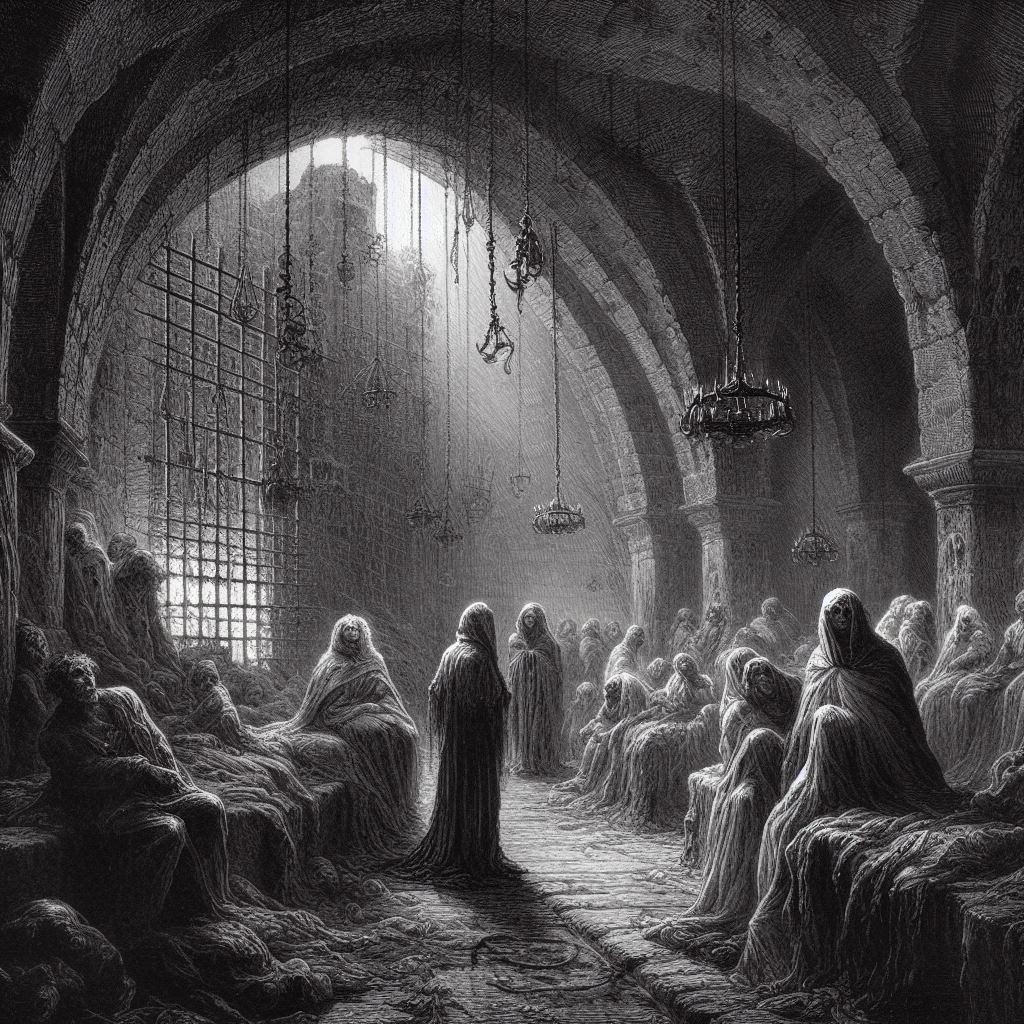
 No fiction this time. I had a difficult time coming up with what Lust's stronghold should be. I finally settled on a dungeon. But then I ran into another difficulty. The AI art generator blocks the prompt "Dungeon of Lust" for some reason (can't imagine why). So I had to cheat a little. The first set was generated with the prompt "The Dungeon of Longing."


And the next set was generated by the prompt "The Prison of Desire".


Hopefully I'll get back to Liangyu next week.

Monday, February 12, 2024

The Hall of Gluttony

        There are acres upon acres of fields and pastures, orchards and stocked lakes. As you draw nearer, you pass bakeries and confectionaries, breweries and factories. The hall itself is set upon a hill. Once there was a pleasant garden here, but that is long gone. In its place is a sprawling compound. The back is given to vast kitchens and stockyards. Smoke and steam rise unremittingly from a forest of chimneys. The front of the structure is shaped like the head of some gargantuan boar, with the entrance lying in its open maw. A red carpet leads up to it. From within issues a smell like a thousand dive bar dumpsters.

        The Cult of the Tongue hold their debauch incessantly, with a fervor that eclipses most saner faiths. Each member trades years of promise for days of indulgence, in a vain attempt to infinitise the ephemeral. To be sure, you may leave if you will. But the wills of most here have swiftly atrophied.

        Newcomers to the cult earn their place within the first hall, Edacity. Its red walls and Corinthian columns glow dully under a wan sun. Stripped like athletes for the course, the neophytes rowdily begin. Some sample as many different varieties as they can; others gorge themselves on the same thing repeatedly. Troughs for vomiting stand against the walls. These beginners must still purge their stomachs occasionally to continue the meal. Once they no longer require this step, they are ready to move on to the next hall, Gulosity.

        Gulosity is more sedate, if only because those who make it here have begun to lose the use of their legs. Solomonic pillars hold up the vaulted ceiling. Two long tables hold the course. Wax of a thousand scented candles pools on the pea-green tablecloth, catching crumbs and other fragments. Servants are quick to whisk away empty trays and replace them with fresh viands. Some is organic, birthed from the earth and blessed by the sun. Some is sludge churned from a machine. All is defiled by Gluttony's touch.

        The marble floor is slick with spilt drinks, vomit and worse things. There are privies and washrooms nearby but most cannot bear (mentally or in some cases bodily) to leave the table for so long, and have brought chamber pots with them to do their necessary business in. Pages stand in the shadows, ready to empty them when filled.

        In side chambers are sunken dens for consumers of hashish, opium, and other drugs. The Halls cater to those who seek nothing beyond the present. The Dens are for those who reject even that gift. Here intoxicants and narcotics of all kinds are to be found-- anything that dulls or distorts the senses. All is for the asking, in extreme overabundance. The mind is destroyed some time before the flesh finally gives out. Bodies are regularly carted out from here and dumped in the fishpond or the pigs' feeding grounds.

        The final hall, Esurience, is for the most devoted. A more intimate setting, but no less ornate. Fruits the size of skulls are piled against the wall. Crows fly through the hall, tearing live flesh from guests so engrossed in their feasting that they do not notice that they themselves are being consumed. Swarms of flies and other insects buzz around the heaps of decaying food.

        Looking around, one sees evidence of bodily corruption. Tumors, immense folds of fat, skin stretched near to the bursting point. But it is the souls that are the most debased. It is not unheard of for one guest, craving something new, to attempt to devour his neighbor.

        When one of Gluttony's elites can truly eat no more, they are congratulated and ushered down a long stairway. Far below the overburdened foundations of the house lies a vast cavern, hollowed out by eons' worth of grease and refuse. The Lord of Excess reclines in a great pit in the center. Gluttony on his throne resembles nothing so much as a corpulent maggot feasting on humanity. Here his Perfected are brought before him, having fattened to the ultimate limit. One by one they are lowered into his ever-gaping jaws, too bloated to even think, much less scream.

Tuesday, February 6, 2024

Tombs of the Xin

    I have hitherto refrained from addressing the rather distasteful subject of graverobbing. However, as I know many among my readers take part in (and in some cases have developed a reputation for) this practice, I am bound to touch upon it.


    The Xin tombs (at least the ones worth plundering) are generally laid out in a spiral pattern ascending toward the center, representing the soul's journey up the World Mountain to the Bright Halls. This is known as the Luóxuán style. But the various executions of this theme may differ wildly. A tomb may be at the summit of mountain. Another may be on an upper level of a tower wrapped in a coiling stairway. Or the path to the tomb may be underground within an artificial mound. Always the path will spiral inward, clockwise, generally with stations as checkpoints representing the Heavenly Barricades of popular belief. There may be side passages containing treasure or ceremonial artifacts.


    Traps are to be expected, as are supernatural guardians. Unlike most Liangyese, the Xin do not utilize ghosts as guardians. They feel that to keep a man's soul trapped in such a way is to deprive him of his destined apotheosis-- a worse crime than even murder. Necromancers who dabble in such activities are advised to not draw attention to themselves while sojourning here. But "animated" corpses (which function on a basic set of spells without any need for full sapience) are allowed, as they are in the rest of the country. There are also tomb guardians of a more otherworldly nature.


    Five or six centuries ago, it chanced that two wizards arrived in Xin from parts unknown, bringing arcane lore from their own distant homelands. At that time a particularly ruthless breed of tomb raiders were operating in the area, and the Xin were eager for stronger security measures. Enter Talhaller and Beshu. These two hired themselves out and summoned familiars to fill the role of immortal sentries. Their business rivalry was the stuff of legends, and their dedication to the hustle impressed even the Xin. Talhaller's particular brand of sprite was the Guardian, a capriform entity armed with a spear and capable of long leaps. Beshu, on the other hand, summoned the Watcher, a large floating eyeball with a vast set of powerful tentacles. Both species are to be considered highly dangerous.


    If you do decide to plunder a tomb, there are several factors to consider. First, it may well have been plundered long before you got there. Second, the local gangs may present a problem getting in or out. A crime lord may decide to back you if you present it to him nicely and ofer him a cut-- but only if he thinks your plan will succeed. Of course you should first make sure he isn't closely related to the deceased, or too concerned about divine retribution. Law enforcement presents its own set of headaches. I am told that the local rates for bribery are considerably higher than would otherwise be typical, due to a variety of economic reasons.


    These days, of course, the Xin are more enlightened and have left off placing fabulous riches in their graves. Modern dogma states that the gods really fancy pewter and stone, having plenty of gold and silver up there already. Basically any tomb built in the last hundred years is not going to be worth your time.


    My scribe Hoshab informs me that I am legally obligated to state the following: The Cutthroat's Compleat Guide to Liangyu does not endorse the plundering of tombs and the desecrating of corpses. The author does not offer advice in the hopes of encouraging any manner of illegal or immoral activity, and will not be held responsible if said activity results in unpleasant consequences for any parties involved. On your own head be it.

Tuesday, January 30, 2024

The Vault of Greed


    Greed's Temple to Mammon stands on a high mountain range. It is said that one can see all the kingdoms of the world from these peaks. The facade is of classical design with gilt pillars, but the building itself is more modern. It appears to have been added on to by varied minds in diverse ages. The temple contains all the amenities one would expect for the center of one of the world's oldest and most established religions, including a state of the art broadcast studio. The Lord of Lucre presides over services every Monday morning, but followers can catch up on the latest message at their convenience, on air or online. Greed is second only to Lust in media exposure.

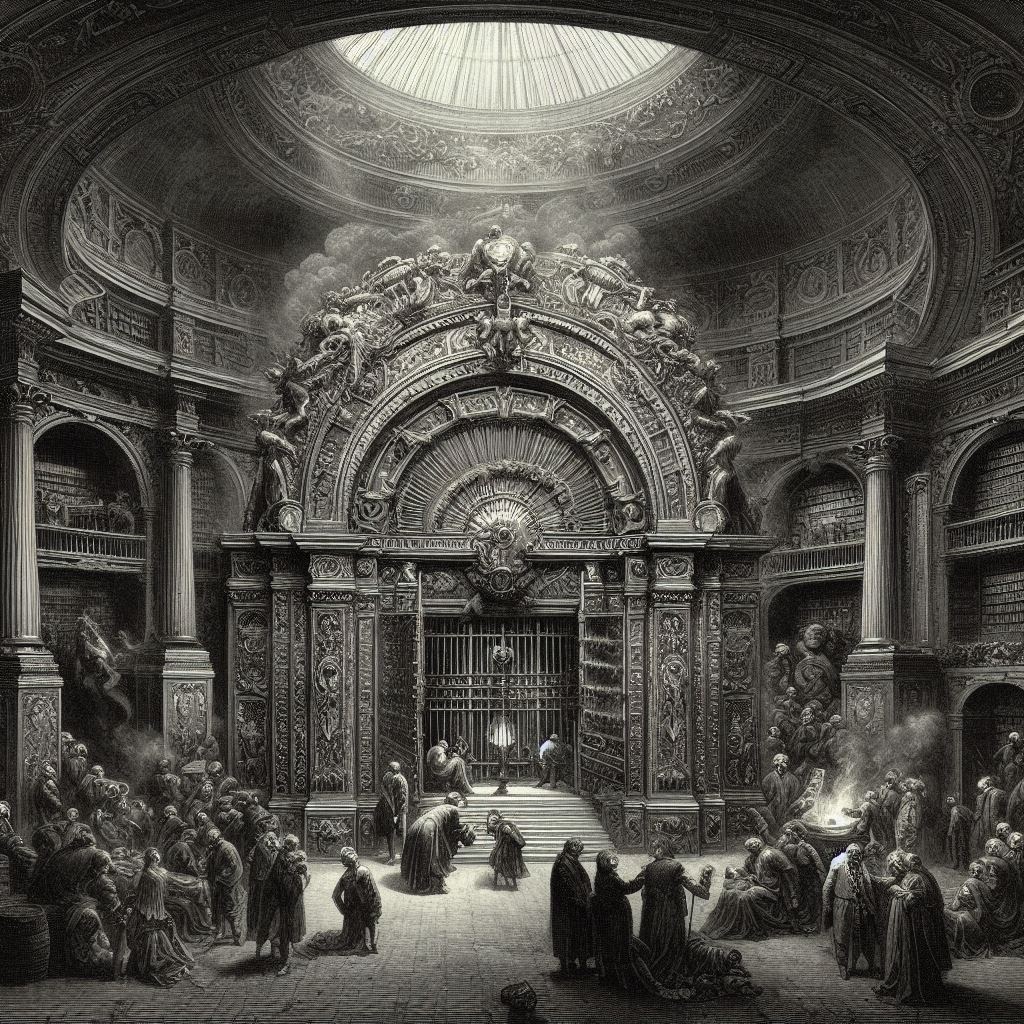
    The Temple is open to all, but the Vault is only for members. The chamber containing the first great door is modelled on something like classical lines. Made of Tyrian bronze, the Gate of Grasping will open only to those who pay the steep entrance fee. Members from around the world bring many such investments in hopes of profitable returns. After paying, the new Initiate is sprinkled with "gold dust", actually ground-up pyrite, and allowed within. This section is as far as most followers get. The price of admission climbs higher as the Vault gets deeper.

    Deeper within the mountain one comes to a somewhat Baroque chamber lit by a sky-well and ringed with bookcases full of ledgers. This room contains the next door, the Gate of Avarice, made of steel bars covered with silver. Here, would-be entrants must surrender all belief and even opinion to the Great Device. A detailed record of each one's words and deeds is kept, to be used against him if the Device deems it advisable. The policy of the Device is slowly but continually shifting, so that what was acceptable one year is anathema the next. Bent to its will like grass to the wind, the new Adepts enter Avarice and trudge ahead, past exhausted mineshafts that are now used for storage.

    At the end of the long sloping tunnel is the last chamber. The room is artificially lit from the top, where steam from a nearby hot spring is piped in to simulate clouds. The moisture is constantly peeling flecks of sky-blue paint from the cavern ceiling. In contrast, the walls of the grotto are given over to a hideous riot of rococo excess and golden statues. Here one finds the final door, the Gate of Cupidity. Its slender bars are of titanium alloy, coated with gold. A steady rhythmic sound can be heard from behind the doors. One might almost mistake it for the heartbeat of the earth herself. It is thousands of hearts beating in depressing unison, the last sacrifice of Greed's most devoted followers. Having been divested of their final fragment of humanity, the newly Hollowed are given a gray suit and and a beige briefcase. They are then sent forth into the world, conquering and to conquer.

    And yet the hearts drone on in dull monotony: "More... More... More..."

Monday, January 22, 2024

Gods-in-Waiting: The Xin


       North of the Shan hills lies the land of their allies, the Xin. The Xin capital, Zei Shufang, lies at the terminus of the Great Road, the trade route that brings goods from the distant west. Access to this trade route has made the Xin wealthy, earning them the envy and ire of the Huo kings and many of the feudal nobility. The former King had been making plans to move his capital to Xin and take control of it directly at the time when the Shan started their rebellion. The Xin were not eager to have their ancient liberties infringed upon, so it seemed natural for them to join the Shan. The alliance has prospered, and they continue to do a brisk trade (with hefty markup), despite catering to a smaller number of provinces.

The Xin stand out. Brown and red hair are common, a mark of their mixed ancestry. The laws of the marketplace govern their conduct. The quiet stall sees no traffic, so Xin tend to be loud, outgoing, and shamelessly self-promoting. Whereas in the rest of Liangyu even nobles are expected to be reserved and self-deprecating, a Xin commoner will begin listing all of his skills and accomplishments within moments of meeting you. He will constantly be mentioning people he knows who could get you a really good bargain on this or that. And he will keep bringing these things up at every opportunity.

Like his pride, a Xin man wears his passions openly. Lamentations of sorrow or boisterous declarations of love are given with drama and earnestness. He is also quick to lash out with word or hand if he feels slighted. But his anger passes just as quickly, and he will soon be laughing and buying the next round of drinks. A Xin seems to have little thought of revenge or resentment. When pressed on this, he may shrug and say "Grudges earn no gold." Or he may laugh and say "If it's a fight you want, just wait till I'm a god. Then we'll have a proper match."

And here lies another oddity about the Xin, their view of the afterlife. It seems to be a matter of perspective. While a pious Shan's view of the Bright Courts centers on his deified ancestors, the Xin is fixated on his own future apotheosis there. Both are theologically correct (at least, according to the ancient traditions), but the two attitudes could not be more strikingly different. A Xin's entire life is thought to be a grand journey toward a glorious enthronement.

Perhaps it is this self-assurance which makes them so ostentatious with regards to appearance. They wear exotic furs and expensive fabrics worked into bold patterns of varied hues. Jewelry is also popular, the gaudier the better. It doubles as wealth storage, at least for those strong or nimble enough to keep hold of it. There are plenty of quick hands eager to relieve them of the burden.

Thieves of all stripes are a constant problem here. Most work in highly organized networks, each with its own chieftain who plans heists and protects underlings with bail and bribe. In return he takes a fixed cut of the loot. Lone wolves do crop up occasionally, but they rarely last. It is a difficult thing to dodge both criminals and the law, particularly when they work so well together. Of course, you could always hightail it for the desert, but you'd better have a faster horse than the gendarmerie.

The introduction of western horses has changed life for the Xin. Liangyese horses tend to be small, best used in teams to pull wagons or chariots. The new horses being imported are stronger and swifter, allowing for the the development of true cavalry. The Xin have taken to them quickly, riding into combat wearing bright silk over bronze armor and yelling piercing war cries. Fearless and energetic, Xin warriors have made a name for themselves both as soldiers in the war and as caravan guards along the Great Road.

The Xin have profited greatly from the war, both in plunder and the arms trade. It is rumored that some of them are playing both sides by selling to the enemy, hoping to drag the war out as long as possible. This is hotly denied and would be a major scandal if it could be proved.

Tuesday, January 16, 2024

The Last Book

    A little book lies unopened on the floor of Sloth's tomb.

    It was once larger. Far larger, they say, containing all of the Great Books which had yet to be written. Not the most well-written or the most read, but the most crucial-- the books that shape the destiny of a world.  Whenever an author completes one of these in the realm outside, the text of that work disappears from this tome. The strange volume has diminished greatly over time, as its pages vanish from beneath its cover to appear in the hands of humanity.

    What the truth of this matter is, I cannot say. I did not open the book on either of my visits, as my purpose was otherwise and time was pressing. But I can attest that it was noticeably smaller the second time I was there. Rather disturbingly so. I can only guess, but surely there is room for only one more book within those few pages.

    The Last Book! What will it say? What minds will grapple with it, and to what path will its words bend them? Who will wrest this Book, the Last Book, from the House of Unbeing?