Tuesday, November 14, 2023

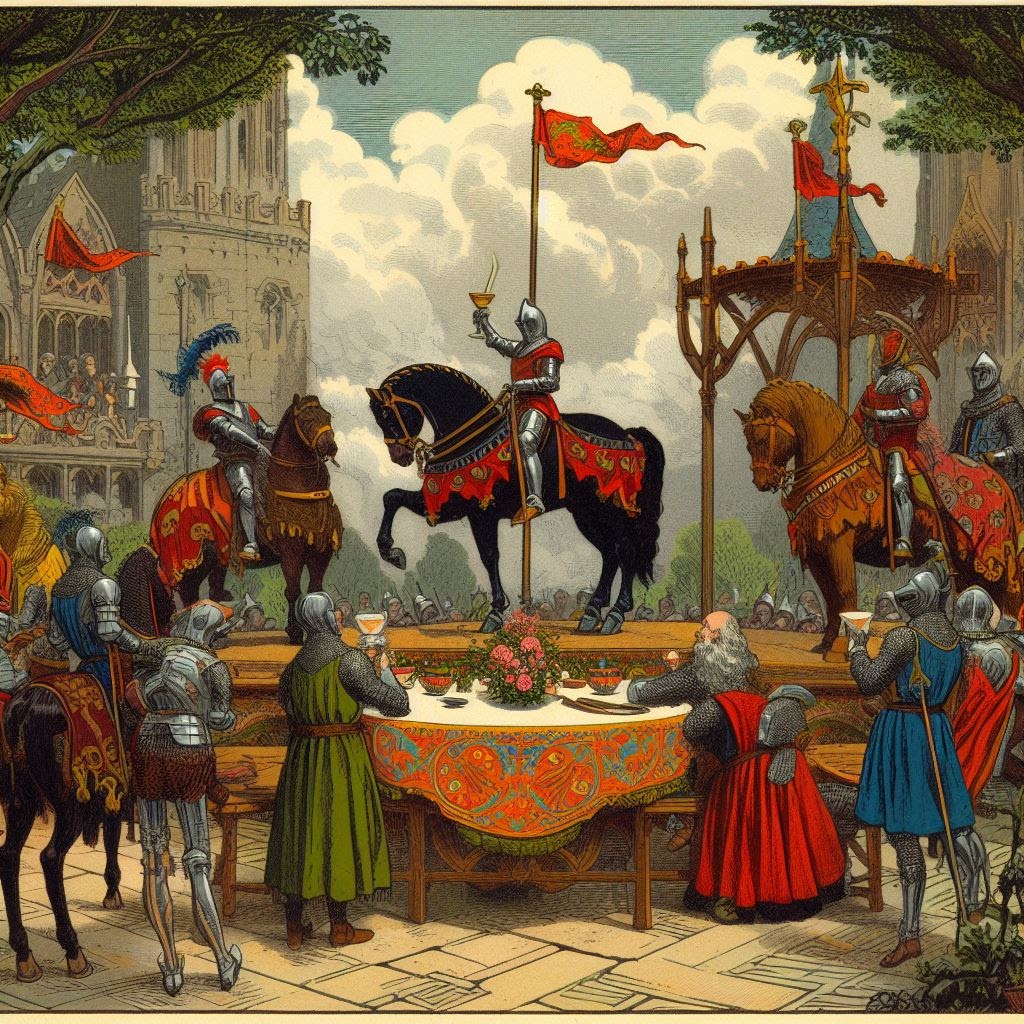
The Untold Tales of the Round Table


Introduction: In which the Author explains his Intentions, in the Form of a Prologue


Many diverse and sundry tales have been told, whether by Geoffrey of Monmouth, universally condemned as a liar, or Sir Thomas Malory, who probably made stuff up too, but did it with style. Of these twain, most of the tales of King Arthur and the Knights of the Round Table have come down to us. However there were some tales which neither Monmouth nor Malory saw fit to include in their works. These have been collected from various sources, and I list here a portion of the Table of Contents, so that the reader may have a sampling of the flavor of these tales.


BOOK II

CHAPTER III-- Wherein Merlin transformed himself into a sparrow.

CHAPTER IV-- How that sparrow was immediately eaten by a hawk.

CHAPTER V-- How that hawk had gross indigestion.

CHAPTER VI-- The hawk landed on the ground and bashed its head repeatedly against the bole of an oak tree, to render itself senseless.

CHAPTER VII-- How it fell senseless and was immediately consumed by a bear.

CHAPTER VIII-- How the bear was fallen upon by hunters, which slew it

CHAPTER IX-- How it was prepared for a meal in King Arthur's court (with a list of the various herbs and spices which were used to prepare it)

CHAPTER X-- How when the bear was opened, Merlin emerged alive and unharmed

CHAPTER XI-- How the Knights of the Round Table did vomit, and swore never to eat bear again (or at least during Lent)


BOOK III

CHAPTER IX-- How Gutred, leader of the Saxons, defied Arthur by speaking unfavorably of his parentage.

CHAPTER X-- How Arthur responded in kind, referring to Gutred's mother in ungentlemanly terms.

CHAPTER XI-- More of the same.

CHAPTER XII-- Gutred's reply.

CHAPTER XIII-- Lancelot's rebuttal.

CHAPTER XIV-- More of Lancelot's rebuttal (This chapter has unfortunately been edited by a scribe who wrote in the margin: "By the Saints, never should a Christian man hear such churlish speech!)

CHAPTER XV-- The resulting battle and slaughter which ensued due to Lancelot's outrageous smack talk.


BOOK IV

CHAPTER XXXVII-- Wherein Sir Lancelot, having gotten high off of Merlin's herbs, went berserk

CHAPTER XXXVIII-- How he slew seven knights of the Round Table who went to subdue him, lopping off their heads

CHAPTER XXXIX-- How he didst also slay many commoners and many Pictish prisoners of war (but no one cared about them, for they were Picts)

CHAPTER XL-- How Merlin didst reattach the heads of the seven knights and caused them to have the semblance of life

CHAPTER XLI-- How in this state they didst prophesy and show many marvels

CHAPTER XLII-- Having ceased their prophesying, they didst march into the churchyard and dig for themselves seven graves, and bury themselves in them


BOOK V

CHAPTER XII-- How there was some confusion about the names and identities of Sir Belvidere and Sir Bedivere, due to careless pronunciation


But I shall not weary the reader. It is obvious why these tales were not included in Malory's work, being of sensational and sometimes contradictory material. One excerpt however, I wish to draw to the reader's attention in full and shall hopefully do so in another missive.

Monday, November 13, 2023

Liangyu, a Kingdom Divided

  To the east of the Imavant is a land in turmoil.

For centuries, the Huo Dynasty ruled Liangyu in prosperity and peace. In the west, a line of border Dukes known as the Shan defended the kingdom from sporadic incursions of canid tribes. Science and art flourished in a thousand forms. All seemed well.

King Chengshi took as his chief wife a daughter of the Shan, in a move meant to cement the bonds between the two families. The son of this union, Prince Chou, was designated the heir and grew to be a well-respected soldier and statesman. But the King, nearing old age, developed an infatuation with a young concubine named Xiyi and began to dote on her to the exclusion of all else. Eventually he installed her as the new Queen and named their newborn son the Crown Prince. After an attempt on their lives, Prince Chou and his deposed mother fled to her father's court in the west. Outraged by the shameful treatment of his daughter and grandson, the mighty Duke of the Shan raised the banner of rebellion. Allying with some canid clans, he brought war to Liangyu.

The King was unpopular and few nobles answered his call to arms. Were it not for the wooden automatons that made up the bulk of his army, it is doubtful he would have held out. In the event, the first battle was close-fought, and both sides fell back to lick their wounds. Afterward, the Shan alliance with the dogmen galvanized the King's vassals to rally to his side, fearful that their lands and titles would be conquered by the barbarians. The war dragged on, and neither side could win a decisive victory.

This was all decades ago. Both King and Duke have passed on, but the war continues, in spurts and lulls, among their descendants. The concubine's son now reigns in the east, backed by his nobles and the family of artificers who create his automatons. In the west, Chou's three sons maintain their father's right to the throne, and with the help of the Shan and their canid allies they seek to claim it.

The cultures of the two factions have begun to drift apart, or perhaps the ongoing conflict has simply revealed divisions which already existed. The coastal east looks to the sea and the southern jungles of Argathras, importing exotic goods-- and faiths. The creed of the Teacher has begun to take root in the this country, to the discomfort of some of its more conservative elements. And everywhere one sees the various types of automata and other devices that have been developing over the past few generations. The west, by contrast, is landlocked. But it holds a near monopoly on the brisk trade which runs north thru the Sokot Desert and then west to far-off lands. The Duke's people have become experts in silk production-- as have many of their canid allies. While the dogmen had long been some of Shan's most implacable foes, a common enemy (with rich lands to plunder) seems to have united the two groups. How long this arrangement can truly last, who can say.

Automata are rare in the lands of the Shan. The easterners guard the secrets of their craft closely, and many of the rural folk of the west distrust their innovations. They tend to view the east as decadent, dishonest, and far too quick to put their trust in lifeless machines. Meanwhile, the easterners take pride in their sophistication and progress, viewing the Shan as blunt rubes, or even barbarians. Their alliance with the dogmen is felt to be a deep and unimaginable betrayal. But, they grudgingly admit, Shan courage and resourcefulness is undeniable.

Still, it is too simple to dwell exclusively on the two warring houses. Some nobles are still trying to maintain neutrality, and others seek to play the factions against each other. A few have switched sides, some more than once. There are also isolated clans and domains which have never bent the knee to the Huo kings. There are commoners just trying to go about their business in peace. And there are more unusual characters too. Wandering scholars go about, unearthing old secrets. Alchemists travel across the kingdom to procure ingredients for their elixirs, leaving strange rumors in their wake. Students of the martial arts hone their bodies to the breaking point in pursuit of perfection. And, of course, rogues of all stripes ply their shadowy trades on both sides of the border.

And, in the background, lurk wilder and stranger things.

Tuesday, November 7, 2023

The Whistler

In general, the aerial creatures of Mars known as "drifters" consume food by ingesting their prey whole. This keeps most from being a great threat to human visitors, as they are limited to swallowing creatures smaller than themselves. The toxins in their tentacles are still harmful to a human, and a drifter that feels threatened or startled is likely to lash out. But most kinds will tend to avoid human-sized beings if possible.

There are, however, two main exceptions. We will discuss one today.


The whistler is a drifter that has several specialized tentacles which contain "leeching tubes". Once it has paralyzed a victim with its toxin, it inserts the leeching tubes into its prey and proceeds to suck up nutrients from the victim's body. This method of feeding allows the whistler to live off creatures larger than itself, and also to share its prey with others of its kind.

In other words, they hunt in packs.

Like most drifters, the whistler propels itself by forcing air through its aeolian ventricles. This method allows it to reach roughly the speed of an average human's walking pace. Faster speeds require preparation. The whistler has a specialized bladder-like organ which it will gradually fill with highly pressurized air. To achieve top speed, the whistler will let the air out in a swift stream, pushing the animal swiftly forward and causing the high-pitched sound for which it is named.

They commonly rely on ambush tactics, using trees or rocks as cover, tethering themselves with their tentacles. Conserving their energy by remaining in one place, they can go for months without eating. Once suitable prey comes within range, they emerge and strike quickly with a speed burst.

Conversely, whistlers may simply drift on the air currents. They can even harness a favorable wind by extending a retractable fin known as the artemon, which functions as a sail. This is useful for longer migrations or excursions in search of prey. Once a potential target is spotted, a pack may stalk their quarry, gradually hemming it in on all sides. Their energy expenditure is fairly low when moving at a normal speed. If they can tire out their quarry, they will move in when it stops to rest or collapses from exhaustion. If they seek to end things more quickly, they may use the speed burst to close the distance. 

Whistlers are opportunistic, and will not hesitate to feed off another predator's kill if possible. They may even scavenge carcasses that have been dead for some time. Like most drifters, they can use their tentacles to snag smaller prey, such as birds or small skyrays, which they swallow whole. The paralytic toxin numbs the animal while it is digested in the main compartment of the whistler's body. A whistler's digestive system is highly effective. Even bones and cartilage are  broken down and consumed.


Whistlers have no fear of humans and will actively hunt them if they sense an opportunity. Even one sting may leave you unable to move for hours-- long enough for a whistler pack to completely exsanguinate you. Dress in thick clothing that covers the majority of your body. If you should encounter a whistler, fire is typically the most effective method of dealing with them. The gas which keeps them aloft is highly flammable. Be careful not to get caught by the resulting explosion. The whistlers are wary of fire and the sight of it may be enough to keep them at bay-- for a time. They probably can afford to outwait you.


Author's note: I had to watch this during research, so now you do too. Them's bloggin' rules.

Monday, October 30, 2023

Imavant, Roof of the World

    The valleys and peaks of Imavant are home to creatures that speak and think but are not men.


    After the defeat of the Serpent Kings, the Gods returned to their original plan of developing humanity. But the god Zaldohin did not wish to see the other two kin, the simian and the lupine, fall into nothingness. And so he created the Preserve, here on the highest place in the world, near the gods themselves. And he appointed the Deathless Wardens to be their eternal protectors. The two species must not die off. This is the Wardens' pledge.


    The Lupine clans scattered throughout Imavant, hunting deer in the rich valleys and squabbling amongst themselves. Humans typically call the varying types of this kindred "dogmen". The apes grew in wisdom and built their hallowed city of Shanidel. Some call them yeti.


    The Wardens patrol the bounds of the realm. Anyone approaching from the outside is warned. If they do not heed the warning, they are fought. The Wardens, who appear otherwise human, have exceptional skill and can perform acrobatic feats that seem physically impossible. They may also manipulate matter and energy to some extent. They do not appear to age, but this is said to be due to a fruit cultivated at their headquarters, on a sacred and forbidden peak. They appear to be wholeheartedly devoted to their mission.


    The boundary lines of the Preserve are marked by a series of great stones, often carved with faces. Some of the faces seem more or less human, others are strange and unearthly, of no known species. No two faces are alike. Each stone is just in eyesight of the two next to it, in a great ring around the mountains. Very few humans have been allowed past this ring.


    The tribes of dogmen are allowed to fight among themselves to a certain point. If it seems that the warfare threatens the survival of the species, the Wardens will step in. Conflict between yeti and  dogmen is entirely forbidden. It is doubtful that the high walls of Shanidel could be scaled or breached by the dogmen anyway. The majority of the yeti seem to have no interest in the mundane world beyond their walls, preferring to spend their time studying lore or meditating on deep mysteries.


    Both dogman and ape are bound to honor Zaldohin for allowing their species to continue. They give thanks to him upon attaining adulthood, upon being wed, upon the birth of their own children, and upon their deathbed. Besides these things, Zaldohin has no formal worship or sacrifices. The few humans who have interacted with the Wardens have not been able to determine which of the ancient gods the name Zaldohin refers to. It has, thus far, not been found in any known human records or traditions.


    The dogmen are free to leave, but not to return. The Wardens will not allow the Imavant to be a safe house for raiders. Tribes and packs of dogmen have often emigrated and sought to establish a foothold in the outside world. Some have managed to do so, more have failed. 

Saturday, October 28, 2023

The Black Cypress

    Although not a true cypress, the Black Cypress has been termed such by Terran visitors due to certain superficial similarities. The Martian name is not shared with visitors due to a local religious belief. In fact, Martians will avoid speaking of the tree at all, and if they need to draw attention to one, they will simply gesture in its direction. The reasons for this are obscure and beyond the scope of this article.

    First time visitors to the Sands are struck by the tall, slender trees which grow scattered about the dunes. How these plants manage to thrive in such an arid environment is a matter of debate. Some argue that the tree gathers what trace amounts of water it can from the air and whatever recent rainfalls may hit the area. Others believe that the deep roots of the tree reach hidden reservoirs. A still more controversial claim is that the tree has developed to live not off of water, but a black viscous substance found in pools below the surface, similar to the tarry sap the tree occasionally extrudes.

    During its lifespan, the cypress may have a noticeable impact on an area, as sand piles around its root system and forms a strong dune. Desert shrubs may grow in the organic material it sheds. Shaodan lizards have been known to dig burrows in the relative stability of its root system, using their petrifying spit to harden the tunnel surfaces. Skyrays drift lazily among its branches in ponderous mating rituals.


    When the cypress has exhausted what nutrients it can extract from the soil, the tree rapidly desiccates and detaches from its root system. It becomes very lightweight, and uses its last bit of energy to create thousands of tiny seeds. When one of the powerful windstorms that periodically sweep the sands comes by, it will pick up the lightweight trunk and carry it off to another area, scattering seeds in its wake. This also makes Martian sandstorms particularly dangerous, as in the blinding cover of the storm one is in danger of being hit by a flying tree.


[Author's Note: Images generated via the Image Creator on Bing. The concept of tall, slender black trees among white and pink sand dunes was inspired by the photos in this article.]

Wednesday, October 25, 2023

Ayis, the Primal Blade

    Bent past the breaking point, the apes rebelled against the Serpent Kings. And so, war came to Argathras.


    Weapons had not yet been conceived by mortals. The war was fought with fist, fang, and claw-- and crude but terrible magic. The apes fought valiantly; but for every battle won, another was lost. The struggle seemed unending, and the apes feared the dying of the light even in the dawn of the world.


    In desperation, they called upon the gods who had given them thought and purpose. The greatest of their shamans summoned the chieftains of their dog-men allies, and journeyed to a sacred fane in the heart of the jungle. There, upon an altar of uncut stones, they piled fallen branches and fragrant herbs and lit them ablaze. It is not known what nameless things they offered on that altar, strangled and broken. But at the end, when the flames had died away, the gods answered with fire of their own.


    In the midst of the ashes lay a sword, gleaming grim in the dim light. A scarlet gem lay in the hilt, pulsating like a heartbeat. "I am Ayis," whispered a voice in every mind. "Show me your enemies."


-----------------------------------------


    Ayis, the Primal Blade, is an avatar of the platonic ideal of "Sword", made manifest in the physical realm. It is a straight, pointed sword of an unknown material resembling iron. The grip of the handle appears to be bone. The sword does not break, bend, chip, rust, or corrode.


    Because it is the original, of which all blades are an imitation, or perhaps because of some virtue the gods placed in it, all bladed weapons are reluctant to meet it in combat. Any bladed weapon gets a sizeable penalty attacking or being attacked by it-- swords, knives, spears, halberds, arrowheads. Non-bladed weapons such as a club or a bullet are not penalized. The gods probably built in a way to keep it at bay from them or theirs if necessary. Picture a god whistling and the sword immediately comes to heel. It will not allow itself to be raised against a god.


    Ayis has something akin to consciousness, however its entire mind is of an alien nature, being totally bent on the purpose for which it was made. A sword may sing, but it does not compose songs. Ayis' whole delight is in warfare and slaughter, and it rejoices in shedding blood. The grim set of its mind is communicated with the one who carries the sword. The longer a mortal bears Ayis, the more in tune their souls become, until it becomes difficult to say which one is the wielder and which the weapon. Such mortals become great tacticians and strategists, with a genius for all forms of warcraft. However, their wrath and their violent tendencies are greatly intensified, and they may be as dangerous to a friend as they are to their foes.


    If Ayis pierces the heart of a living being, the minerals and certain organic material within the corpse will gradually coalesce into a lesser copy of Ayis. Like Ayis, these "corpse blades" are nigh-indestructible. However they do not share its other powers. Early humans uncovered the blades, grown within the remains of many serpentine corpses. These swords became the model and pattern of swords that humanity crafted thereafter. Because of these things, Ayis is also called Father of Swords.


-------------------------------------


    After defeating the hosts of Nog, the apes built a house for Ayis. They built it around the altar where the Sword first appeared, using unhewn rocks which somehow fit together with barely a seam. In time, men found the shrine and entered. They could not read the strange signs painted upon the walls, but the Sword's name rang in their minds as soon as they laid eyes on it. Only one man survived the quarrel over who would pluck the blade from its resting place.


    A thousand years of warfare followed. The sword changed hands mostly by means of murder, betrayal, or theft. At last, by fate or providence, it came into the possession of a pious king. He returned it to the sanctuary, and bade his mages lay such spells upon the door that no thief would enter. But that was long ago, and who can say how long such magecraft lasts? Meanwhile Ayis sleeps, dreaming crimson dreams.

Saturday, July 31, 2010

Aetius Remembers...

We met them at the field. Our troops prevailed, but this was no victory. No invincible army standing strong. No honored Legionnaires gladly defending their Empire. We fought, the barbarians fought... and now, standing here, I wonder why.

For years we fought for her, for her undying glory. She was the Eternal City, bringing light and beauty to a savage world. She simply was, and we did not question it. It is not that we failed to see the fall into decadence... we lived it. When the screams of innocent victims in the Colosseum were drowned out by the roar of the mob, remember whom that mob was comprised of. It was not the Goths or the Scythians... just as it was not Attila who burned men alive to light his banquets.

Attila... I had him that day at Chalons. I had him in my power and could have destroyed him but I did not. Is it ironic that I could only save Rome by letting her enemy go? No matter. Later generations may debate as they like, I handled the situation as I saw fit... and that meant playing our barbarians against each other.

And in the end, of course, it was all in vain. She will fall, as she would have fallen had there been no Attila, no Huns, no war. For her true death is from the inside, by inches, while grey-haired men in white robes debate and point their fingers in blame. And all the while we have kept vigil, fought and died, filling the gaps in our ranks with men of the same stock as our foes. Even at Chalons we would never have prevailed were it not for an alliance with barbarians.

Theodoric and his Goths... Theodoric died in the battle-- trampled, they say, by his own cavalry. Another irony. For though I live and he dies, yet my people will fade and the barbarians flourish. And when it is all over, even our descendants will not know what it was that we fought for.


Omnia romae venalia sunt. Cecidit babylon magna. Finis.